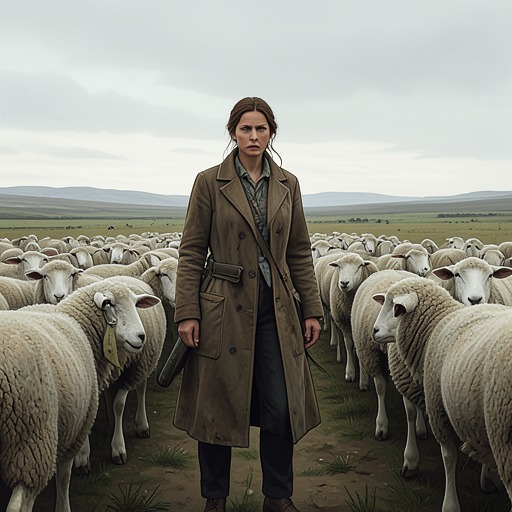
Rebecca discovers and hands over George’s smuggling cache
Three Bags FullRebecca discovers and hands over George’s smuggling cache in an episode that converts a half-understood human secret into material evidence, then puts that evidence—and her own safety—at risk. A key on a string leads her to packets buried beneath the dolmen; there she finds not only the contraband but also a file and a videotape. When a man arrives at George’s caravan, his account confirms that George worked for a smuggling firm, while his denial about the murder leaves the central killing unresolved.
The cache beneath the dolmen
The discovery follows the loss of George and the flock’s uncertain adjustment to life without their shepherd. His body had been found beside the hay barn, with a spade projecting from it; elsewhere, people’s talk had already suggested that the attractive pasture and its isolation concealed a more profitable use. In particular, local speculation linked George to nighttime boats bringing goods ashore, their transfer to his caravan, and his departure in an old car the next day. That account was suspicion, not proof. The cache makes the suspected trade tangible without answering who killed him.
The immediate path to it is small and accidental. Rebecca comes out of George’s caravan after hearing a lamb cry. On the steps she notices a key hanging from a string, picks it up, and follows the sound beneath the dolmen. The flock has prepared the ground: Othello has scraped away earth so the hidden box will be easier for her to find. Rebecca laughs when she uses the key, as though the discovery has turned a neglected object into the answer to a puzzle.
Inside, she takes out a small packet and bites through its string. Plastic crackles, and something dry crumbles in her fingers. She recognizes the material as grass; the flock, smelling it too, understands at once that it can be eaten. The packets recall journeys George had made with his sheep to another pasture, when he called the trips Operation Polyphemus. Each sheep had carried one of these small, string-tied packets beneath its belly and deep in its fleece, unaware of what it contained. What had seemed like an unexplained routine now reads as a means of transporting contraband with the flock.
Rebecca does not stop at the first packet. Holding her skirt out like a bag, she gathers all she can find beneath the dolmen: many small packages, a larger rectangular one, and a file of papers. She carries the overloaded bundle back to the caravan and remains out of sight for a time. The contents are not all alike. The packets are the drug the humans have called grass; the file holds information important enough that its eventual visitor describes it as a threat to his firm; the rectangular package proves to be a videocassette, though he says he has never heard of it.
Rebecca’s account and the personal cost
Before the visitor arrives, Rebecca reads aloud and then puts the book aside. She tells a story about a girl with two fathers, one publicly acknowledged and one secret. The girl and her secret father are fond of one another, but after a quarrel they stop speaking. When he writes that he plans to travel to Europe and wants to see her first, she hides her happiness and keeps him waiting; he dies before they meet. The story makes Rebecca’s relation to George legible as more than a matter of inheritance or investigation: George was her secret father, and their estrangement had left a final meeting unrealized.
The telling is surrounded by the recovered contraband. Sweet, heavy smoke drifts over the meadow after Rebecca returns to the caravan with the cache, and the sheep grow sleepy. Mopple, however, has been intent on tasting the packets ever since their contents were identified. While Rebecca sits outside in the dark, he finds an open one and swallows its contents before she notices. By the time she sees him, he is licking the last crumbs from the caravan steps. His impulsive theft later matters to the count: the visitor finds twenty-three packets, one fewer than the cache had originally contained, and calls the missing portion sheep feed.
The sequence sets two forms of appetite beside each other without making them equivalent. The flock recognizes edible grass through smell and taste; the humans have made that same material part of a commercial operation, concealed in the wool of animals who do not know they are carrying it. Rebecca’s discovery gives her the facts, but not a simple resolution. Her story of the absent father places grief and delayed understanding beside the practical danger of the cache, while the sheep’s accidental consumption leaves a physical trace in the visitor’s accounting.
The firm’s representative
At night, a powerful car approaches the meadow without lights. A man gets out, crosses to George’s caravan, pauses to sniff the air, and knocks several times. His arrival makes the buried cache more than an archive: someone connected to its former use has come to retrieve what remains. The scene is observed by the flock, whose attention to scent and movement registers the tension around the caravan even when it cannot know everything being said inside.
The man identifies George as one of the firm’s best operatives, a specialist on consignments between Ireland and Northern Ireland, and describes his record as having been free of incidents. Rebecca asks whether the operation was really all for grass. The man says it was mainly grass, but that cigarettes and other goods were also carried when the market demanded them. The answer confirms that the cache belongs to a broader, adaptable trade rather than a single shipment. His description also gives a sharper meaning to the earlier suspicion about boats, the caravan, and George’s old car: the pasture’s apparent isolation was compatible with an organized route for moving goods.
The file changes the balance of the encounter. The man points out that Rebecca has it and says its information could deal the firm a severe blow. She tells him she will do nothing with it; he says he believes her, but insists that belief is not enough. His apology, followed by the caravan’s light going out, marks the exchange as threatening without making the threat’s exact form explicit in the flock’s account. The sheep sense a heavy, oppressive, violent disturbance inside. The event therefore does not reduce the handover to a straightforward recovery: Rebecca possesses leverage, the visitor has power, and the consequences of the documents remain unsettled.
Handover and unresolved consequences
The visitor eventually denies that his firm had anything to do with George’s death. He says that no one in his line was responsible and contrasts the killing’s theatrical, almost ritual quality with the firm’s methods, which he says do not depend on that kind of intimidation. His statement narrows one possibility but does not identify the murderer. The killing of George remains an open question, and the man’s assurance is still the claim of an interested representative rather than a solution established by the scene.
He counts the packets as he removes them from the makeshift bag in Rebecca’s skirt: twenty-three, with one packet of sheep feed missing. He takes the file as well. When he notices the rectangular package, Rebecca identifies it as a videocassette; he says he has never heard of it and pockets it too. The count makes Mopple’s earlier theft part of the evidence’s physical history, while the cassette introduces information the firm apparently did not expect to find among the goods. The scene does not disclose what the recording contains, so its significance remains a possibility rather than a revealed answer.
Before leaving, the man carefully lifts Rebecca’s hand and kisses her fingertips without speaking. He returns to his car and drives away without saying goodbye. The gesture gives the transaction a personal, uneasy close, but it does not undo the imbalance or settle what the man’s apology meant. Only when the engine can no longer be heard does the flock relax. For a moment, the caravan again holds George’s daughter; Gabriel and his voracious sheep have disappeared, and Europe seems within reach. That sense of restored order is brief: the night continues to bring people into the meadow.
The episode’s pastoral setting is therefore also a working landscape, a hiding place, and a route through which goods have passed. The green pasture, the sheep’s wool, and the small packets belong to the same chain of events, though the flock initially knows only the first two as parts of its world. By letting Rebecca uncover the evidence while the sheep interpret it through smell, appetite, and remembered journeys, the scene reveals the trade without making the animals understand its full human machinery. It also separates two questions that had seemed joined: George’s smuggling work is confirmed, but the identity and motive of his killer remain unknown.